
Packing for a trip often comes down to a delicate balancing act between bringing what you need and keeping your bag light. When it comes to audio gear, the last thing you want is a bulky headset weighing you down at the airport or taking up half your carry-on. That’s why finding the right pair of lightweight JBL headphones for travel matters so much. But with so many models available—over-ear, on-ear, and true wireless—it’s easy to get overwhelmed. This guide will help you cut through the noise, understand what actually makes a headphone travel-friendly, and choose a pair that fits your specific needs without weighing you down.
Key Takeaways
- Travel-friendly headphones should prioritize weight, foldability, and battery life over raw audio specs.
- JBL offers excellent lightweight options across three main styles: over-ear, on-ear, and true wireless earbuds—each with distinct trade-offs for travel.
- Active Noise Cancelling (ANC) adds weight and cost, so consider whether you truly need it for your travel environment.
- Check the case size and clamping force, not just the headphone weight, to ensure true portability and comfort.
- For the best blend of portability and sound, focus on models with efficient drivers and long playback times rather than the heaviest bass response.
What Makes a Headphone “Travel-Friendly”?
Travel-friendly means more than just having a wireless connection. It means the device is designed to be unobtrusive, durable, and comfortable in the specific scenarios you’ll face on the road. A good travel headphone should disappear from your mind so you can focus on your movie, podcast, or simply getting some sleep on a long flight. When evaluating any pair of lightweight JBL headphones for travel, you need to look at four key factors: physical weight, folding mechanism, battery endurance, and the carrying case.
Why Weight and Clamp Force Matter on Long Flights
The stated weight of a headphone (usually measured in grams) is your first data point. However, the perceived weight on your head is often more important. This is determined by the clamping force—how tightly the ear cups press against your head. A headphone that is technically light but clamps firmly will cause fatigue faster than a slightly heavier model with a gentler grip. For long-haul flights, look for over-ear models with plush memory foam earpads that distribute pressure evenly. On-ear models are lighter, but they press directly on your ears, which can become uncomfortable during a 10-hour flight. If you tend to wear glasses, a lighter clamping force is essential to avoid pressure points on your temples.
The Role of the Carrying Case
Many people make the mistake of only checking the headphone’s weight without considering the case. A “portable” headphone that comes with a bulky, rigid case is not actually easy to pack. For travel, the case should be either a compact hard shell or a soft pouch that can be squished into a backpack. JBL headphones typically ship with either a hard-shell case that hinges open or a lighter drawstring pouch. The hard-shell case offers better protection for checked luggage, while the pouch is better for maximizing space in a personal item. Consider where you plan to store them—if they are going in a crowded backpack, you want a case that offers some crush resistance without adding unnecessary bulk.
JBL Headphone Styles: Which Is Right for Your Trip?
JBL has a diverse lineup, and choosing the right style is the first major decision. There is no single “best” option for everyone because the ideal choice depends on your itinerary, your packing style, and your personal comfort preferences. Here is a breakdown of the three main categories to help you decide which direction to lean.
Over-Ear vs. On-Ear vs. Earbuds
Over-ear headphones (like the JBL Tune 770NC) offer the best sound isolation and comfort for extended wear because the ear cups encompass your ears. They are heavier, generally weighing between 200 and 250 grams, but they are often foldable. On-ear headphones (like the JBL Tune 510BT) rest on your ears. They are significantly lighter (often under 160 grams) and more compact, but they provide less isolation and can create hot spots on your ears. True wireless earbuds (like the JBL Vibe Beam or JBL Endurance Peak) are the ultimate in lightweight portability, weighing just a few grams. They are perfect for quick flights and gym sessions but have smaller batteries and are easier to lose.
| Feature | Over-Ear (e.g., Tune 770NC) | On-Ear (e.g., Tune 510BT) | True Wireless (e.g., Vibe Beam) |
|---|---|---|---|
| Weight | 200–250g | 150–170g | 50–80g (with case) |
| Comfort (Long Flights) | High (cups around ear) | Moderate (pressure on ear) | High (if fit is correct) |
| Portability | Requires case | Compact neckband | Pocket-sized case |
| Noise Isolation | Excellent | Good | Good (with proper seal) |
| Battery Life | 40–70 hrs | 30–40 hrs | 6–10 hrs (case recharges) |
Key Features to Prioritize for Travel
Once you decide on a style, you need to evaluate the specific features that will make your travel experience smoother. While sound quality is subjective, travel features are objective and can be measured. Focus on these three pillars: battery life, connectivity, and physical controls.
Battery Life and Charging Speed
Battery anxiety is real, especially during long layovers or international flights where power outlets are scarce. Look for a pair that offers at least 20 hours of playback on a single charge. For over-ear models, JBL often pushes this to 40–50 hours with ANC off. A quick-charge feature is also a lifesaver—a 5-minute charge that gives you 2 hours of playback is incredibly useful if you forgot to charge your headphones overnight. For true wireless earbuds, check the battery life of the case. The case should provide at least two additional full charges to get you through a full day of travel.
Multipoint Bluetooth and Wired Fallback
Travel involves switching between devices constantly—watching a movie on your tablet, taking a call on your phone, and maybe connecting to your laptop for work. Multipoint Bluetooth allows you to connect two devices simultaneously, so you can switch between your phone and laptop without going through the arduous process of disconnecting and reconnecting. Additionally, consider whether the headphones offer a wired connection via a 3.5mm audio jack. This is a hidden gem for travel. If you are seated in an older airplane seat with a wired entertainment system, having a physical cable that plugs into your headphones ensures you don’t have to buy a clunky adapter or stay awake for the whole flight because you can’t hear the movie.
Is Active Noise Cancelling (ANC) Worth the Extra Weight?
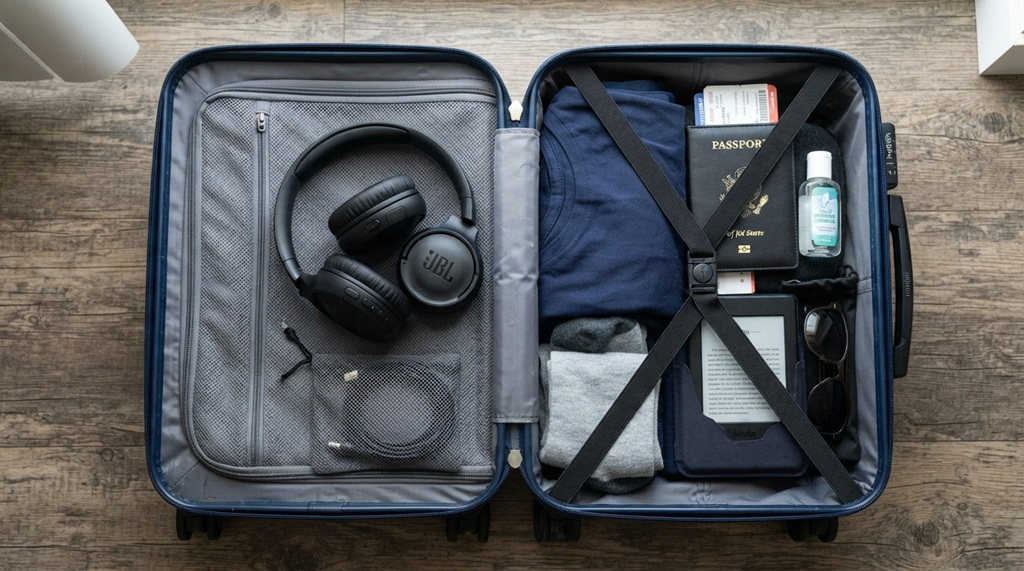
ANC is often the most talked-about feature in headphones, but it is not always necessary for travel. Understanding where you will use the headphones will help you decide if it is worth it. ANC is excellent for drowning out the constant hum of jet engines and air conditioning. However, it adds a few grams of weight and increases the cost. If you are a budget-conscious traveler who mostly uses headphones to listen to podcasts in quieter environments or in a hotel room, a good passive seal (from well-fitting ear cups) may be sufficient. Conversely, if you know you will be spending hours in loud environments like a bus, a plane, or a busy airport terminal, ANC is a worthwhile investment that reduces listening fatigue because you won’t be tempted to crank the volume to unsafe levels.
Do You Need Transparency Mode?
If you choose to get ANC, look for a model that also includes “Ambient Aware” or “TalkThru” functionality (JBL’s names for transparency mode). This is crucial for travelers. During a flight, you need to hear the flight attendant announcements without removing your headphones. In an airport, you need to hear the gate change announcement. Transparency mode uses the built-in microphones to let outside sound in with the touch of a button. Without it, you will constantly have to pause your music and remove the headphones, which is a minor but annoying friction point during travel.
Curating the Ideal JBL Travel Model for Your Profile
Selecting the ideal lightweight JBL headphones requires matching key performance attributes directly to your personal travel requirements rather than simply purchasing a flagship tier. Long-haul flights demand ergonomic over-ear padding and superior active noise cancellation to neutralize engine hum, whereas fast-paced urban commutes call for compact, foldable on-ear designs that stash effortlessly into a daypack. Tailoring your choice to your specific itinerary ensures you balance portability, acoustic performance, and battery life without paying for redundant features. If your transit routines focus heavily on local travel and noise suppression, explore our dedicated guide on choose ANC headphones for daily use in illinois.
The Minimalist Packer
Best choice: True wireless earbuds (like JBL Tune Buds).
If you are traveling with just a backpack or a small purse, you don’t want a headband cluttering your packing. Earbuds take up virtually no space. They are perfect for commuting between destinations, quick flights, and listening to music while walking through a new city. The trade-off is you must remember to charge the case every day or two, and it is easier to lose a tiny earbud on a plane than a bulky headset.
The In-Flight Movie Watcher
Best choice: Foldable over-ear headphones (like JBL Tune 720BT or 770NC).
If your primary need is to watch movies and block out the airplane engine noise, you want maximum comfort and battery life. Over-ear headphones with a foldable design (where the ear cups rotate flat) fit nicely into a backpack sleeve. The larger drivers typically provide better audio dynamics for movies compared to earbuds, and the physical ear cups keep your ears warm on a chilly flight.
The Multi-Device User
Best choice: Models with Multipoint connection.
You need to be reachable on your phone while also listening to a movie on your tablet. Prioritize headsets that advertise seamless switching between two devices. This feature is increasingly common in mid-range JBL headsets, but verify it in the specs sheet before purchasing. This saves you the awkward fumbling of holding down the power button to reconnect when your phone rings.
Common Mistakes to Avoid When Buying Travel Headphones
Even with the right features in mind, shoppers often fall into a few predictable traps. Avoiding these will save you money and frustration.
Ignoring the Comfort of Ear Pads
Many budget models use synthetic leather ear pads that trap heat. After two hours of wear, your ears will sweat and become itchy. For travel, specifically look for “plush” or “memory foam” ear pads. These conform to the shape of your head and breathe better. You can always buy aftermarket ear pads (like those from Wicked Cushions) to upgrade a budget pair, but that is an extra expense and hassle you can avoid by choosing wisely initially.
Focusing Only on Frequency Response
JBL is known for a “fun” and bass-heavy sound signature. While this is great for hip-hop and pop, it can be exhausting to listen to for long periods. High frequencies can become sibilant and tiring. When reading reviews, look for comments on “soundstage” and “vocal clarity,” not just bass depth. For travel, a neutral-to-slightly-warm sound signature is often more comfortable for long listening sessions than a V-shaped curve that emphasizes bass and treble.
Frequently Asked Questions
How much do JBL travel headphones typically weigh?
JBL on-ear headphones typically weigh between 150 and 170 grams, while compact over-ear models range from 200 to 250 grams. True wireless earbuds weigh under 10 grams per earbud, with the charging case adding roughly 50–80 grams to your pocket or bag.
Can I use JBL headphones with the airplane seat audio jack?
Yes, if the headphone has a 3.5mm wired input. Many over-ear JBL models include an audio cable. You will likely need a double-pronged airline adapter (a tiny Y-splitter that allows two people to share one seat jack). These are inexpensive and sold at most airport electronics kiosks.
Are JBL headphones with ANC good for travel?
Yes, they are excellent for travel. JBL’s Adaptive Noise Cancelling technology is effective at reducing low-frequency noise like engine rumble. Models like the JBL Live series or Tune 770NC offer a good balance of noise cancellation and price, making them ideal for frequent flyers.
Is it better to buy earbuds or over-ear headphones for a trip?
It depends on the trip duration and your tolerance for in-ear pressure. For short domestic flights and daily commutes, earbuds are more convenient and lightweight. For long-haul international flights, over-ear headphones are generally more comfortable because they do not plug your ear canals, allowing for less pressure buildup during altitude changes.
How do I know if the JBL headphones are durable for travel?
Look for models with reinforced headbands and hinges. The folding mechanism is the most common failure point. When you handle them in a store, gently twist the headband to see if it creaks. Also, check if the ear cups swivel—models with swiveling cups are often designed for high-stress use and are easier to pack flat.
Conclusion
Selecting the right pair of lightweight JBL headphones for travel doesn’t have to be a compromise. By focusing on the weight of the case, the comfort of the clamping force, and the practicality of battery life and connectivity, you can find a pair that enhances your journey rather than adding stress. Whether you choose the immersive isolation of over-ear models or the pocket-sized convenience of earbuds, the best travel headphones are the ones you forget you are wearing. Prioritize the features that match your travel style, and you’ll be ready for your next adventure. If you are still on the fence, exploring detailed breakdowns of specific JBL wireless models can help you finalize your decision with confidence.