The World Health Organization estimates that 1.1 billion teenagers and young adults are at risk of hearing loss from unsafe listening practices — and the damage begins in childhood with headphones that parents assume are safe because they’re marketed to kids. Choosing safe noise cancelling headphones for kids without damaging hearing means understanding that volume is measured in decibels, damage is cumulative and irreversible, and most “kids’ headphones” without explicit dB-limiting technology can reach the same harmful volumes as adult headphones.
Safe kids’ noise cancelling headphones are specifically engineered with hardware-based volume limiters (typically capping output at 85dB) combined with active noise cancellation that reduces the child’s impulse to raise volume above safe levels to overcome background noise. The dangerous irony? Children raise headphone volume specifically because environmental noise masks their audio — meaning noise cancellation actually serves as a hearing protection feature by eliminating the need to turn volume dangerously high. This guide explains exactly how to select hearing safe headphones for kids that protect developing ears while delivering the audio quality and noise reduction children need for studying, traveling, and entertainment.
How Does Loud Audio Damage Children’s Hearing?
Loud audio damages hearing by destroying the tiny hair cells (stereocilia) in the inner ear’s cochlea — these cells convert sound vibrations into electrical signals for the brain, and once destroyed by excessive volume, they never regenerate, creating permanent hearing loss that accumulates invisibly throughout childhood.
The damage mechanism explained:
- Hair cell destruction: The cochlea contains approximately 15,000 hair cells at birth. Exposure to sounds above 85dB for extended periods physically damages these cells through mechanical stress and metabolic exhaustion. Each damaged cell represents a permanent frequency gap in hearing ability.
- Cumulative and irreversible: Unlike cuts that heal or bones that mend, cochlear hair cells do not repair or regenerate in humans. Every instance of excessive volume creates incremental permanent damage — even if the child doesn’t notice reduced hearing immediately. Damage accumulates silently over years.
- Children’s increased vulnerability: Children’s ear canals are shorter and narrower than adults’ — meaning sound pressure reaching their eardrums is 7–9dB higher than the same source would deliver to adult ears. Headphones at “safe” adult volume are actually delivering louder sound to children’s eardrums due to acoustic physics.
- Delayed detection: Early hearing damage affects high-frequency ranges first — frequencies less critical for daily conversation but important for music appreciation, speech clarity in noisy environments, and academic performance. Parents typically don’t detect the problem until damage is substantial enough to affect speech comprehension.
Safe exposure guidelines (WHO/AAP):
| Volume Level | Safe Daily Exposure Duration | Reference |
|---|---|---|
| 85 dB | Up to 2 hours | Recommended kids’ limit |
| 90 dB | 30 minutes | Noisy restaurant level |
| 95 dB | 15 minutes | Lawn mower distance |
| 100 dB | 5 minutes | Many unrestricted headphones at 70% volume |
| 105+ dB | Under 1 minute | Many unrestricted headphones at full volume |
What Makes a Kids’ Headphone Truly “Hearing Safe”?
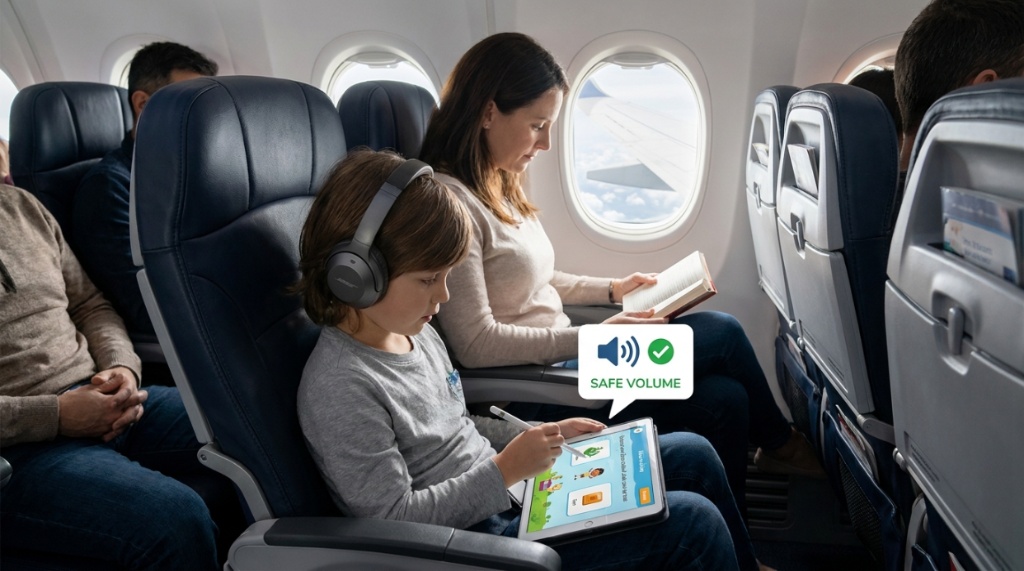
A truly hearing-safe kids’ headphone has a hardware-based volume limiter that physically prevents output from exceeding 85dB regardless of source device volume settings — not software-based limits that can be bypassed, overridden, or circumvented by children.
Safety feature hierarchy (most to least reliable):
- Hardware volume limiter (most reliable): A physical circuit or resistor that electrically limits maximum output. Cannot be bypassed by any device setting, app, or child’s ingenuity. The speaker physically cannot produce sound above the limit regardless of input signal strength. This is the only truly safe option for young children.
- Firmware-locked digital limit (reliable): Volume ceiling programmed into the headphone’s processor that the user cannot modify. More sophisticated than simple resistor limiting — allows features like adjustable parental limit settings while maintaining a maximum ceiling. Reliable if the manufacturer doesn’t allow resets.
- App-controlled parental limit (moderate reliability): Parents set volume ceiling through companion app. Effective while configured — but tech-savvy older children may discover how to factory reset headphones or use different devices that bypass app-based limits.
- Device-level volume limit (least reliable for kids): Setting a volume limit on the phone/tablet. Easily changed by children who know the device passcode or can access settings. Not a substitute for headphone-level limiting.
Critical distinction: “volume-limited” on a product listing doesn’t guarantee the limit is hardware-enforced. Read specifications carefully. True hardware limiting is described as “built-in circuit limiter,” “passive volume regulation,” or “hardware-capped at 85dB.” Software-only limits are described as “parental controls,” “app-adjustable,” or “recommended limit” — language that implies the limit can be changed or bypassed.
How Does Noise Cancellation Actually Protect Hearing?
Noise cancellation protects hearing by eliminating background noise that causes children to raise volume to dangerous levels — research shows children using non-ANC headphones in noisy environments increase volume by 10–15dB above what they’d use in quiet settings, often exceeding safe thresholds without realizing it.
The noise-cancellation-as-hearing-protection logic:
- The volume escalation problem: Children (and adults) instinctively increase headphone volume until content is clearly audible above environmental noise. In a quiet room, 65dB is sufficient. On a noisy bus (75dB ambient), children push volume to 85–90dB. On an airplane (80–85dB ambient), children push to 95–100dB — entering hearing damage territory.
- ANC breaks the escalation cycle: By reducing environmental noise by 20–30dB, ANC eliminates the trigger for volume increases. A child on an airplane with ANC headphones hears content clearly at 65–70dB (safe) because the background noise competing for attention has been electronically removed. Without ANC, the same child needs 95dB to achieve the same content clarity — damaging their hearing throughout the flight.
- Double protection model: ANC headphones with 85dB volume limiters provide two layers of hearing safety simultaneously: the limiter prevents dangerous peaks, and the ANC prevents the desire to approach those peaks. This belt-and-suspenders approach creates the safest possible listening experience for children in all environments.
Study data: a 2020 study in the International Journal of Audiology found that children using noise cancelling headphones in noisy environments chose volume levels 8–12dB lower than children using passive headphones in identical conditions. This 8–12dB difference represents the gap between safe listening and hearing damage — making ANC a measurably protective technology, not merely a comfort feature.
What Volume Limit Should You Choose: 75dB, 85dB, or 94dB?
Choose 85dB as the standard safe limit for ages 6–12 — it provides clear audio at reasonable volume with safe exposure up to 2 hours daily. Choose 75dB for children under 6 or those with sensory sensitivity. Only consider 94dB for supervised teenagers who need audio clarity in specific loud environments (concerts, sports).
Limit recommendations by age and context:
| Volume Limit | Safe For | Daily Duration | Appropriate Ages | Context |
|---|---|---|---|---|
| 75 dB | Extra-cautious protection | Unlimited (no hearing risk) | Under 6, or sensory sensitive | Quiet environments, audiobooks, gentle music |
| 85 dB | Standard safe limit (WHO recommended) | Up to 2 hours continuously | 6–13 | Study, entertainment, travel, general use |
| 94 dB | Supervised louder listening | Under 30 minutes | 13+ (supervised) | Brief use in very loud environments only |
Models with switchable limits (BuddyPhones Cosmos+: 75/85/94dB) offer maximum flexibility — parents set appropriate limits based on the child’s age and specific use case rather than being locked into a single threshold. The default should always be the lowest limit that allows content to be clearly audible — typically 85dB for school-age children in normal conditions.
What Should You Look for When Shopping for Safe Kids’ ANC Headphones?
Look for: explicitly stated hardware 85dB limiter, ANC effectiveness of 20+ dB noise reduction, comfortable fit for smaller heads (adjustable headband), materials free from harmful chemicals (BPA-free, phthalate-free), and battery life exceeding the child’s typical use duration.
Shopping checklist:
- Volume limiting type and level: Confirm hardware-based (not bypassable). Verify stated dB limit (85dB standard). Check whether it’s independently tested or only manufacturer-claimed. Brands like Puro Sound Labs have audiologist-verified limits; generic brands may claim limits without verification.
- ANC quality (noise reduction amount): Effective ANC reduces ambient noise by 20–30dB. Budget models claiming ANC but only reducing 8–12dB provide minimal benefit — barely perceptible to the user. Check reviews specifically mentioning ANC effectiveness rather than trusting “active noise cancelling” label alone.
- Fit for children’s heads: Adult headphones (even volume-limited ones) don’t fit children properly — creating pressure points, poor seal (reducing ANC effectiveness), and discomfort that leads to rejection. Kids-specific models have narrower headbands, smaller ear cups, and lighter clamping force designed for smaller anatomy.
- Material safety: Children’s headphones contact skin for extended periods. Verify BPA-free, phthalate-free, and non-toxic material claims — particularly for ear cushion materials that press directly against facial skin. Reputable children’s brands disclose material safety compliance prominently.
- Battery life vs. use pattern: If your child uses headphones for 2-hour study blocks, battery life must exceed 2 hours comfortably (20+ hours is standard for quality kids’ ANC headphones). Models dying mid-session create frustration that leads to switching to unsafe non-limited headphones as backup.
- Durability: Children drop, twist, sit on, and abuse headphones. Flexible headbands, reinforced hinges, and replaceable ear cushions extend functional lifespan. Fragile adult-style construction fails within months of child use — replacing safety investment with repeated repurchase frustration.
Which Brands Prioritize Hearing Safety for Kids?
Brands that genuinely engineer hearing safety into kids’ headphones include: Puro Sound Labs (audiologist-designed, independently tested limits), JBL (JR series with verified volume caps), BuddyPhones (multi-level safety with Study Mode), and LilGadgets (BPA-free with integrated limiters).
- Puro Sound Labs ($60–$120): Founded specifically to address children’s hearing loss risk. Their volume limiting is independently verified by audiologists. Studio-grade sound quality within safe limits. The PuroPro and BT2200 Plus are considered gold-standard hearing safe ANC headphones. Most recommended by pediatric audiologists.
- JBL JR Series ($30–$70): Major audio brand with dedicated children’s line. 85dB volume limiting across all JR models. JR460NC adds ANC at accessible pricing. Quality audio engineering at mass-market accessibility.
- BuddyPhones ($40–$80): Switchable volume modes (Travel 75dB, Kids 85dB, Toddler 75dB). SafeAudio technology with optional StudyMode (optimizes audio for speech clarity). Designed with input from child psychologists regarding comfort and acceptance.
- LilGadgets ($30–$50): Emphasizes both hearing safety and material safety (BPA-free, toxin-free). Integrated volume limiting without external adapters. SharePort for siblings to share audio without splitters. Budget-accessible with genuine safety engineering.
Brands to approach cautiously: generic Amazon brands claiming “85dB limited” without independent testing verification. Some budget headphones labeled “kids safe” have been independently tested and found to exceed claimed limits by 5–15dB — delivering harmful levels despite safety marketing. Choose established brands with verifiable safety testing history.
When shopping for the right pair, safety extends beyond just internal volume caps. Many modern parents prefer cutting the cord entirely to prevent physical tangles and tripping hazards. Exploring the three benefits of wireless technology reveals how Bluetooth connectivity not only improves physical safety for toddlers but also grants them better freedom of movement during online learning or long family road trips.
Conclusion
Protecting your child’s hearing while providing noise cancelling headphones requires one non-negotiable feature: a hardware-based 85dB volume limiter that cannot be bypassed by the child, the device, or any combination of settings. Combined with effective ANC that eliminates the background-noise-triggered volume escalation responsible for most childhood headphone-related hearing damage, these two technologies create a genuinely safe listening environment that serves your child’s academic and entertainment needs without silently accumulating irreversible hearing loss. Invest in headphones with proven, hardware-enforced limits from brands with demonstrated commitment to children’s auditory health — because the hearing your child loses at 8 years old doesn’t return at 18, 28, or any age thereafter. Choose hearing safe headphones for kids that protect what cannot be restored.
Frequently Asked Questions
Can noise cancelling headphones damage kids’ ears?
The noise cancellation technology itself does not damage hearing — it produces inverse sound waves at safe levels. However, any headphone (including ANC models) can damage hearing if volume is excessive. ANC headphones with 85dB limiters are actually safer than non-ANC headphones because children don’t raise volume to overcome background noise. The ANC feature is protective, not harmful, when paired with proper volume limits.
What’s the safest volume for kids’ headphones?
85dB is the WHO-recommended maximum for children’s headphone use up to 2 hours daily. For children under 6 or those with sensory sensitivity, 75dB provides additional safety margin. No child should regularly listen at volumes above 85dB regardless of duration. Below 70dB, there is essentially zero hearing damage risk at any duration — making lower the better whenever content remains clearly audible.
How can I tell if my child’s headphones are too loud?
Simple test: with headphones on your child at their preferred volume, stand at arm’s length (3 feet). If you can clearly hear the audio content, volume is likely above 85dB and should be reduced. Also watch for: child complaining of ringing after use, asking “what?” more frequently in conversation, or preferring progressively higher volumes over time — all signs of early hearing fatigue or damage.
Are over-ear or on-ear headphones safer for kids?
Over-ear headphones are generally safer because they create a passive seal that reduces ambient noise by 10–15dB — meaning children need less volume to hear clearly even without ANC. On-ear headphones leak more sound in both directions (ambient in, audio out), creating slightly higher volume needs. In-ear earbuds deliver sound closest to the eardrum and can cause damage at lower measured volumes — generally not recommended for children under 12.
Do volume-limited headphones sound worse than regular ones?
At 85dB, audio quality is excellent — this is a comfortable listening level for clear, full-range sound. The volume limit doesn’t reduce audio quality; it prevents excessive loudness. Children accustomed to unsafe volumes may initially perceive 85dB as “quiet” — this perception adjusts within 1–2 weeks as their ears adapt to appropriate levels. The audio itself remains clear, detailed, and enjoyable within safe limits.
Should I buy headphones with adjustable volume limits?
Yes — adjustable limits (like BuddyPhones’ 75/85/94 dB modes) provide flexibility for different contexts: 75dB for bedtime stories, 85dB for daily use, and 94dB for supervised teenage use in specific loud environments. However, ensure the adjustment mechanism requires parental action (physical switch in adult-accessible location or app-locked) rather than a button the child can press independently.